The K-Shaped Economy Is Forcing Companies to Operate Two Supply Chains - Logistics Viewpoints
Affluent consumers continue to reward availability, speed, and service, while financially pressured households prioritize value. Supply chain leaders must increasingly support both operating models at once. By. . .
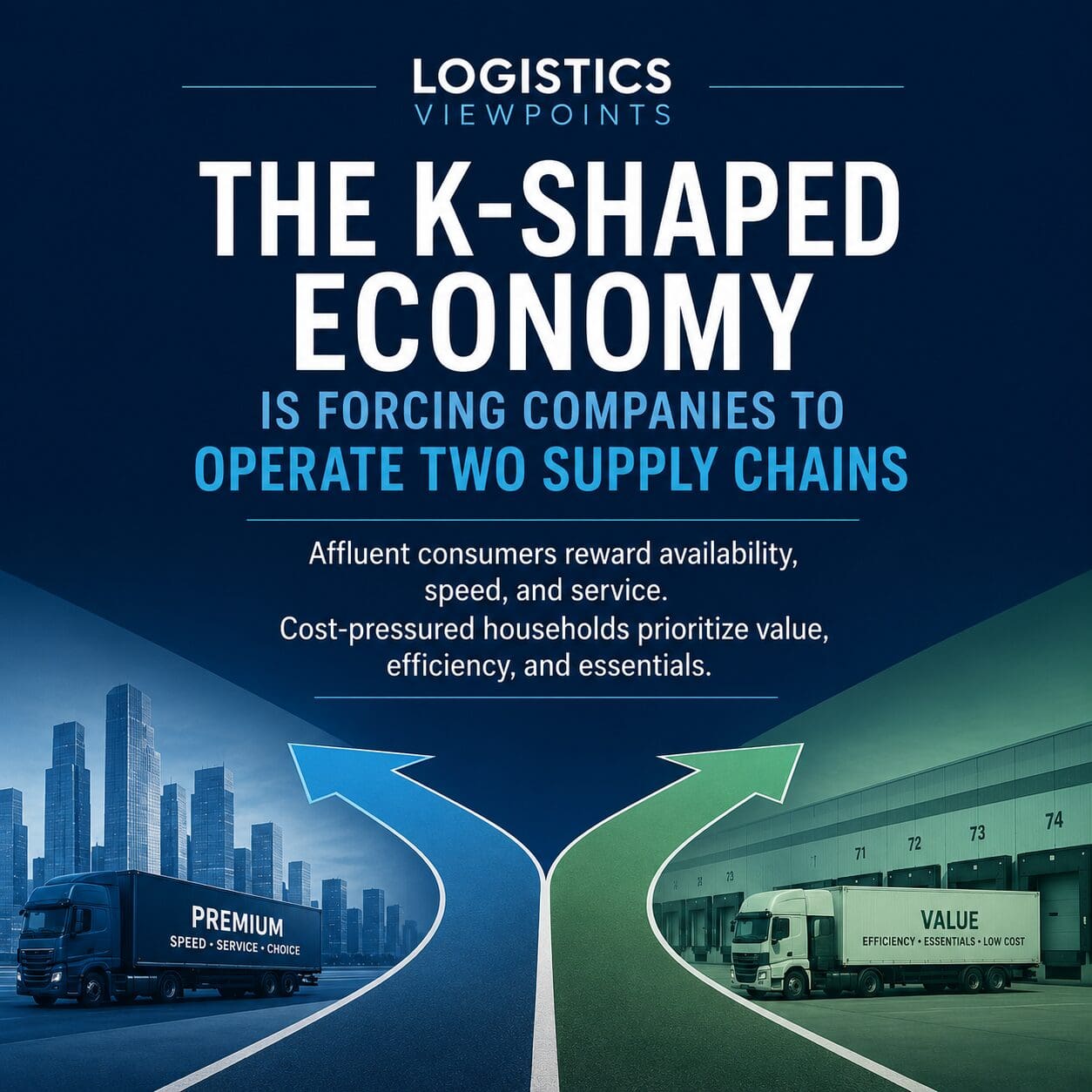
Affluent consumers continue to reward availability, speed, and service, while financially pressured households prioritize value. Supply chain leaders must increasingly support both operating models at once. By Jim FrazerThe economy may still be growing, but consumers are not experiencing that growth in the same way. Higher-income households continue to benefit from stronger financial buffers, asset appreciation, access to capital, and resilient employment in knowledge-intensive sectors. At the same time, many lower- and middle-income households remain highly exposed to elevated living costs, borrowing expenses, and limited wage growth. This divergence is commonly described as a K-shaped economy. The upper arm of the K represents households and industries moving upward, while the lower arm represents those facing continued financial pressure. U. S. Bank argues that this is no longer merely a description of the uneven recovery following the pandemic. It has become a broader structural pattern in which economic shocks, technology investment, inflation, and changing labor-market conditions affect households and industries very differently. For supply chain executives, the K-shaped economy is more than a macroeconomic observation. It is becoming an operating-model problem. Companies can no longer assume that customers within the same market will respond similarly to price, service, assortment, and delivery options. Increasingly, they must serve two distinct demand profiles through supply chains that may require fundamentally different cost structures, inventory policies, and fulfillment capabilities. Rather than optimizing one supply chain, many organizations may need to operate two. Two Consumers, Two Supply Chain PrioritiesHigher-income consumers generally have more capacity to absorb price increases and pay for convenience. They are more likely to value product availability, premium assortments, fast delivery, precise delivery windows, personalized service, and simple returns. Consumers under greater financial pressure behave differently. They are more likely to trade down, switch to private-label products, delay discretionary purchases, search for promotions, buy in bulk, or accept fewer product choices in exchange for a lower price. Recent economic reporting has described this widening divide. U. S. Bank noted that higher-income consumers remained comparatively resilient, while middle-income households were becoming more cautious and lower-income consumers were facing greater pressure from rising costs. The Federal Reserve’s regional economic reporting has also documented cases of lower- and middle-income consumers shifting toward lower-cost products, reducing discretionary spending, and struggling with essential expenses, even as more affluent consumers continued spending on travel, experiences, and premium services. These two consumer groups cannot always be served effectively through the same supply chain strategy. For one segment, service is the differentiator. For the other, cost is the differentiator. The Premium Supply ChainThe upper arm of the K rewards availability, responsiveness, and customer experience. Consumers purchasing premium electronics, luxury goods, specialized equipment, high-end home products, or time-sensitive services are often willing to pay more to obtain exactly what they want, when and where they want it. The supply chain supporting those expectations may require:Broader product assortmentsHigher inventory availabilityInventory positioned closer to demandFaster transportation modesMore regional fulfillment capacityReal-time order and shipment visibilityCustomized delivery servicesFlexible returns and exchangesAdditional packaging or handling requirementsThese capabilities are expensive. They can increase inventory carrying costs, warehouse complexity, transportation spending, and reverse-logistics expenses. However, those costs may be justified when margins are strong, customer lifetime value is high, and poor availability risks losing a valuable customer. In this operating model, the objective is not simply to minimize cost per unit. It is to protect the revenue and margin associated with a demanding customer relationship. The Value Supply ChainThe lower arm of the K requires a different discipline. Consumers facing financial pressure are more likely to prioritize low prices, essential products, promotions, private-label alternatives, and large package sizes that reduce unit costs. The supply chain supporting this segment must minimize unnecessary complexity. That generally means:Narrower SKU portfoliosGreater purchasing concentrationLonger production runsHigher truck and container utilizationMore standardized packagingLower-cost transportation modesSimplified warehouse processesTighter control of inventory carrying costsFewer touches between production and the customerThe narrow-assortment model used by warehouse clubs illustrates the underlying logic. By limiting the number of variations within a product category, a retailer can concentrate purchasing volume, simplify replenishment, improve inventory turns, and reduce warehouse handling requirements. The customer gives up some choice. In return, the retailer can offer a lower price. In this model, operational efficiency is not merely an internal objective. It is part of the customer value proposition. The Real Challenge Is Supporting Both Models at OnceThe premium and value models are relatively easy to describe when they are associated with separate companies. The operational challenge becomes more difficult when both models exist within the same retailer, manufacturer, brand portfolio, distribution center, or transportation network. A single company may sell a premium version and a value version of the same product. One customer may demand same-day delivery, while another is willing to wait several days for free shipping. One product line may justify high safety stocks, while another must operate with minimal inventory to preserve margins. These differences create conflicts across planning and execution. A warehouse may need to support high-speed piece picking for premium e-commerce orders while also moving bulk cases or pallets through highly standardized value-oriented processes. A transportation network may need to manage expedited parcel shipments, scheduled white-glove deliveries, consolidated truckload movements, and lower-cost intermodal freight at the same time. A demand-planning team may need to forecast premium discretionary demand separately from value-oriented essential demand, even when both products sit within the same merchandise category. This is not simply market segmentation. It is operational segmentation. Inventory Planning Becomes More DifficultA K-shaped demand environment complicates inventory strategy. Traditional inventory classification often focuses on sales volume, margin, velocity, or demand variability. Those measures remain useful, but companies may also need to classify inventory according to the service model it supports. Premium products may require higher availability despite slower turns. A stockout on a high-margin item could damage the customer relationship or shift the purchase to a competitor. Value products may require extremely high availability as well, but the economics are different. The business must maintain that availability without accumulating excess safety stock or adding costly handling steps. The result is a more complex set of tradeoffs:Which products warrant additional safety stock?Which products should be positioned close to metropolitan demand?Which items can be centralized in fewer distribution centers?Which orders qualify for premium fulfillment?Which customers should be offered slower, lower-cost delivery?Where should assortment be reduced?Where does greater selection create sufficient margin to justify complexity?A single network-wide inventory policy is unlikely to answer all of these questions effectively. Warehouses Must Accommodate Divergent FlowsWarehouses are often where the K-shaped economy becomes physically visible. Premium flows may require:Individual-unit pickingSpecialized packagingLate order cutoffsRapid order releaseValue-added servicesAppointment coordinationDetailed order trackingValue flows may prioritize:Full-case or full-pallet movementHigh-volume replenishmentStandardized packagingMinimal handlingDense storageHigh equipment utilizationPredictable labor requirementsTrying to force both flows through the same process can undermine each one. The premium operation becomes too slow and inflexible. The value operation becomes too expensive. Supply chain leaders may therefore need to create segmented picking zones, distinct fulfillment rules, separate inventory pools, or even specialized facilities for different customer and product classes. Transportation Networks Face the Same SplitTransportation strategy also divides along the two arms of the K. Premium demand rewards speed, reliability, visibility, and precision. It can support expedited transportation, guaranteed delivery windows, specialized carriers, and proactive customer communication. Value demand rewards consolidation, density, and asset utilization. It favors full truckloads, intermodal transportation, longer planning horizons, fewer delivery frequencies, and reduced accessorial costs. The same logistics organization may need to operate both strategies concurrently. This can create tension in carrier procurement and network design. A carrier selected primarily for low linehaul rates may not deliver the visibility or appointment precision required by a premium service. A highly responsive parcel or final-mile network may be too expensive for low-margin value products. The supply chain must therefore determine where service differentiation creates economic value and where it merely adds cost. SKU Proliferation Becomes More DangerousThe K-shaped economy also raises the cost of poorly governed product portfolios. Premium customers may reward customization and variety, encouraging companies to add colors, sizes, configurations, bundles, and service options. Value customers create pressure in the opposite direction. They reward simplified assortments and low prices. Without disciplined segmentation, companies may attempt to provide broad variety across the entire market. That can produce too many low-volume SKUs, fragmented purchasing, excess safety stock, slower warehouse productivity, and higher obsolescence. The better approach is not necessarily to eliminate variety. It is to place variety where customers are willing to pay for it. SKU rationalization should therefore be tied to customer segment, margin, service requirements, and supply chain cost-to-serve rather than sales volume alone. AI Can Help Manage Multiple ObjectivesTraditional supply chain systems are often configured around a limited number of optimization objectives, such as minimizing transportation costs, meeting a service target, or reducing inventory. A K-shaped market requires more nuanced decision-making. The optimal decision for a premium customer may not be the optimal decision for a value customer. The optimal inventory position for a high-margin, service-sensitive product may be inappropriate for a low-margin staple. Artificial intelligence can help supply chain organizations evaluate these competing objectives at a more granular level. AI-enabled planning systems can incorporate:Customer profitabilityProduct marginDelivery expectationsInventory availabilityDemand variabilityWarehouse capacityTransportation costSupplier reliabilityRegional demand patternsLikelihood of substitutionCost-to-serveThese systems can then recommend different inventory, fulfillment, and transportation policies for different customer-product combinations. However, this requires more than adding a predictive model to an existing planning process. As discussed in ARC Advisory Group’s research on connected AI architectures, supply chain AI increasingly depends on harmonized data, retrieval systems, persistent operational context, knowledge graphs, and communication among specialized agents. These capabilities allow AI systems to reason across products, suppliers, facilities, shipments, customers, and service commitments rather than optimizing isolated transactions. In a K-shaped demand environment, that connected intelligence layer becomes particularly valuable because the supply chain must continuously determine which operating model should apply to each decision. Segmentation Must Extend Beyond MarketingMost companies already segment customers for marketing and sales. Far fewer extend that segmentation into supply chain execution. A customer may be classified as premium in a commercial system while still receiving the same inventory allocation, fulfillment priority, and delivery promise as every other customer. That disconnect limits the value of segmentation. To manage the K-shaped economy effectively, companies may need to connect customer and product segmentation directly to operational policies. Those policies could include:Service-level targetsAvailable-to-promise rulesInventory allocation prioritiesFulfillment-node selectionCarrier and mode selectionOrder cutoff timesReturns policiesPackaging optionsExpedited-shipping eligibilitySubstitution rulesThis does not mean providing poor service to value-oriented consumers. It means designing a service proposition that is economically sustainable for each segment. Supply Chain Metrics Must Also ChangeA single average service level can hide significant operational problems. A company may report strong overall on-time delivery while failing its most valuable customers. It may achieve low average transportation costs while overspending on low-margin orders. It may maintain high product availability while carrying excessive inventory in the wrong segments. Companies should therefore examine performance by customer-product-service combination. Relevant measures include:Cost-to-serve by segmentGross margin after logistics costsInventory turns by service tierStockout rates by customer classExpedite frequencyDelivery-promise accuracyReturns cost by product and segmentWarehouse handling cost per order typeTransportation cost as a percentage of order marginThe purpose is to determine whether the supply chain is delivering the right level of service to the right customer at an economically rational cost. The Strategic ImplicationThe K-shaped economy is often presented as a story about inequality, household finances, or uneven economic growth. For supply chain executives, it has a more immediate implication. The market is separating into customer groups with different definitions of value. One group rewards availability, speed, choice, and convenience. The other rewards affordability, simplicity, and efficiency. Companies that attempt to serve both groups through one undifferentiated operating model risk becoming too expensive for the value market and too slow or inflexible for the premium market. The answer is not necessarily to build two completely separate physical networks. It is to develop the planning intelligence, segmentation rules, operating processes, and execution capabilities required to support two distinct economic propositions within the same network. Consumers are no longer behaving as one market. Supply chains should not behave as though they are. AI Is Reshaping Supply Chain Execution. Here’s What Comes Next. Two ARC Advisory Group white papers on the next stage of AI in supply chain operations. AI is moving beyond isolated copilots and technical architecture into coordinated operational decision systems. This ARC Advisory Group white paper explains how supply chain AI is shifting from capability to execution, where context, governance, workflows, thresholds, and action pathways determine whether AI improves real decisions across planning, logistics, sourcing, fulfillment, and risk management. Download Our Featured White Paper:AI in the Supply Chain Part II: From Architecture to Execution - Defining the Decision Intelligence Layer in Modern Supply ChainDownload Our Foundational White Paper:AI in the Supply Chain: Architecting the Future of Logistics with A2A, MCP, and Graph-Enhanced ReasoningExplore Our DomainsPlanning, Execution & Visibility|Transportation & Logistics Operations|Warehousing, Fulfillment & Automation|Global Trade & Compliance|AI & Advanced Analytics|Data, Integration & Interoperability|Supply Chain Platforms|Risk & Resilience|Sustainability & ESGIndependent ARC research for supply chain leaders and technology decision-makers.