Tamil Nadu Government Aims at $1. 5 Trillion Economy by 2036
The state will release a new industrial policy to foster innovation and technology-driven growth, support emerging industry sectors and drive sustainable development and export promotion.
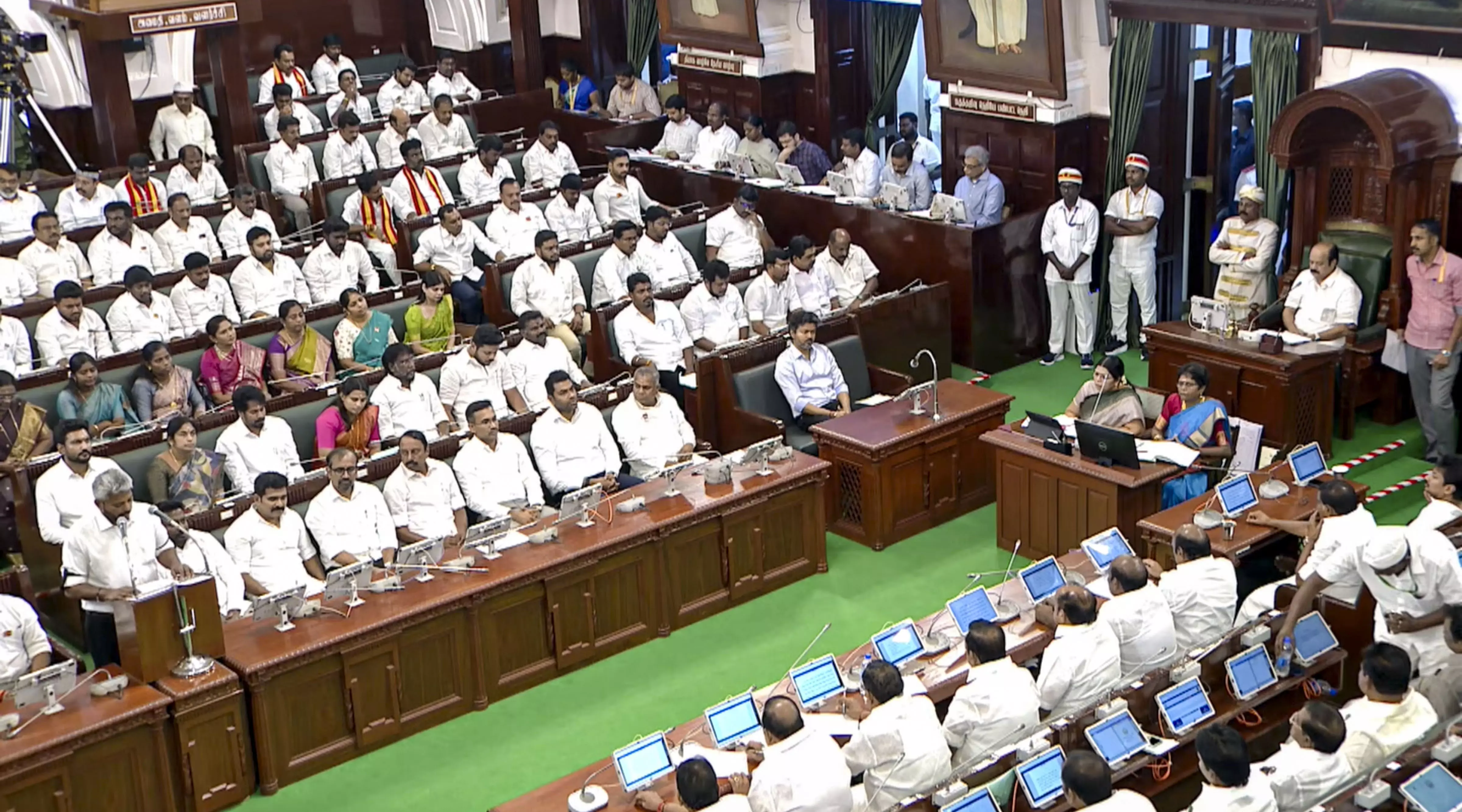
Chennai:Setting a target of driving Tamil Nadu to a 1. 5 trillion US dollar economy by 2036, Tamil Nadu will set up more multi-modal logistics parks and dry ports at strategic locations and establish petrochemical and ancillary industries to encourage large-scale investment and accelerate industrial growth, finance minister, Dr. N. Marie Wilson, said on Wednesday. Presenting budget 2026-27, he said the government was committed to building a friendly ecosystem that promotes industrial growth, attracts investment and generates significant employment opportunities for the youth of the state. The government will also explore the possibility of setting up new ports in Tamil Nadu, he added. The state will release a new industrial policy to foster innovation and technology-driven growth, support emerging industry sectors and drive sustainable development and export promotion. The government will also create an Industrial Capability Directory, a comprehensive digital platform listing the state’s manufacturing and supply capabilities, enabling investors to understand the depth of the local ecosystem. To further enhance Tamil Nadu’s competitiveness, the government will introduce an Artificial Intelligence (AI)-powered investment service system called ‘Guidance 3. 0’, making all requisite information, clearances and services available seamlessly on a single platform for companies seeking to invest in Tamil Nadu. As a key component of this initiative, the ‘Tamil Nadu Single Window Portal 3. 0’ will be implemented in an upgraded form, enabling all statutory approvals, clearances and no-objection certificates required for establishing industries and investment projects to be obtained through a unified interface. This will make setting up of industries and investing in Tamil Nadu remarkably seamless, paving the way to attract new investment and accelerate industrial growth. The global Tamil diaspora, with its long-standing ties with Tamil Nadu, holds immense potential in talent, investment and entrepreneurship. To channel this goodwill into productive investment, a ‘Non-Resident Tamil Investment Facilitation Desk’ will be established within Guidance, to facilitate and promote investment by the global Tamil diaspora in the state. With the objective of ensuring balanced and equitable industrial development across all regions of Tamil Nadu, Sipcot will establish new industrial parks in industrially-backward districts, based on district-specific industrial development plans and each district’s sectoral strengths. These parks will be developed with state-of-the-art infrastructure suited to investors’ needs, at an estimated cost of approximately Rs. 3,200 crore over the next five years. Thoothukudi and Tirunelveli, in southern Tamil Nadu, will be declared as a ‘Space Industrial Investment Zone’, anchored by the strategic significance of the spaceport at Kulasekarapattinam. This is expected to bring about a major leap in the new industrial policy to further strengthen this position. The policy will foster innovation and technology-driven growth, support emerging industry sectors, and drive sustainable development and export promotion. To provide unparalleled infrastructure and technological support to private enterprises, startups and research organisations within the zone, the government, in collaboration with IN-SPACe, is establishing an advanced ‘Space Vehicle Common Technical Facility’. India’s first dedicated AI and Innovation city, named ‘Arivagam’, will be established for AI and deep-tech development, with facilities including an AI university, an international skill development centre, a semiconductor hardware testing lab, multi-domain innovation incubators and modern residential infrastructure. It will serve as a dedicated ecosystem bringing together AI companies, deep-tech startups, quantum technology ventures, enterprise capability centres, researchinstitutions and government AI initiatives, equipped with advanced computing infrastructure, specialised facilities, a skilled workforce, and a collaborative innovation environment.