Megatrends One Year Later – #8: The Circular Economy – What I Predicted, and What’s Actually Happening
jim carroll is a canadian global futurist, keynote speaker, and author — one of the world's top keynote speakers on artificial intelligence, the future of work, and innovation strategy. over a 30+ year career he has delivered more than 2,000 customized keynote presentations to more than 2 million people worldwide internationally.
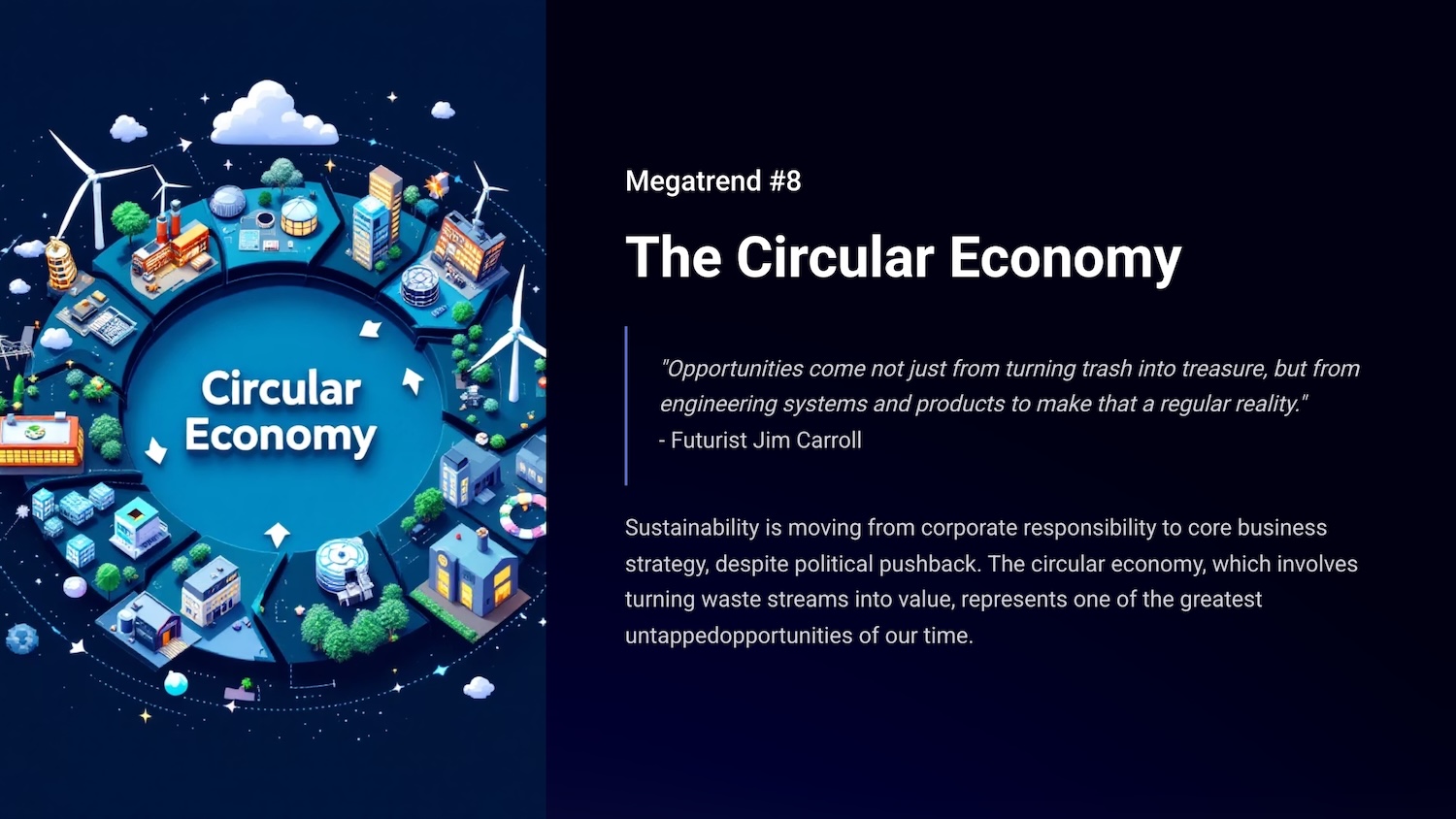
“Opportunities come not just from turning trash into treasure, but from engineering systems and products to make that a regular reality. ”– Futurist Jim CarrollOne year ago, in July 2025, I publishedMegatrend #8: The Circular Economyas part of my 30 Megatrends series. Time to grade myself. The macro number is real — the 2026 Circularity Gap Report puts global linear-economy waste at roughly €25. 4 trillion a year — but the opportunity I described was always sector by sector, and each one moved this year. Electronics is the clearest case: the e-waste recycling market grew past $55 billion in 2026 on its way to $93 billion by 2034, with “urban mining” — pulling copper, gold and rare earths back out of dead devices — now a serious secondary-resource play rather than a niche. Packaging followed the same script: bioplastics hit roughly $21. 7 billion in 2026, compounding near 18% a year, while Pepsi and Coke keep grinding toward their reusable-packaging commitments. Construction is quietly the biggest mover — demolition-waste management is now valued near $227 billion in 2026, heading past $320 billion by 2033, as landfill mandates turn old buildings into feedstock instead of debris. Fashion resale is the fastest: apparel re-commerce is compounding above 20% a year and luxury resale alone is now a $40-billion-plus category — proof Worn Wear and Adidas-style take-back loops were the leading edge, not the exception. Verdict: The sectors are proving out the macro number, not just restating it. Electronics, packaging, construction and fashion are each building real markets on what used to be trash — food and agriculture, the fifth pillar I named, is the one still waiting for its breakout year.