[Interview] Iranians are ‘sick and tired’ after war emboldens regime, wrecks economy
Women walk past an anti-American mural in Tehran, Iran, on June 30, 2026. (WANA/Reuters/Yonhap)When 31-year-old Jeong Si-hun, a Korean doctoral student at the University of Tehran, returned to Iran on June 20. . .
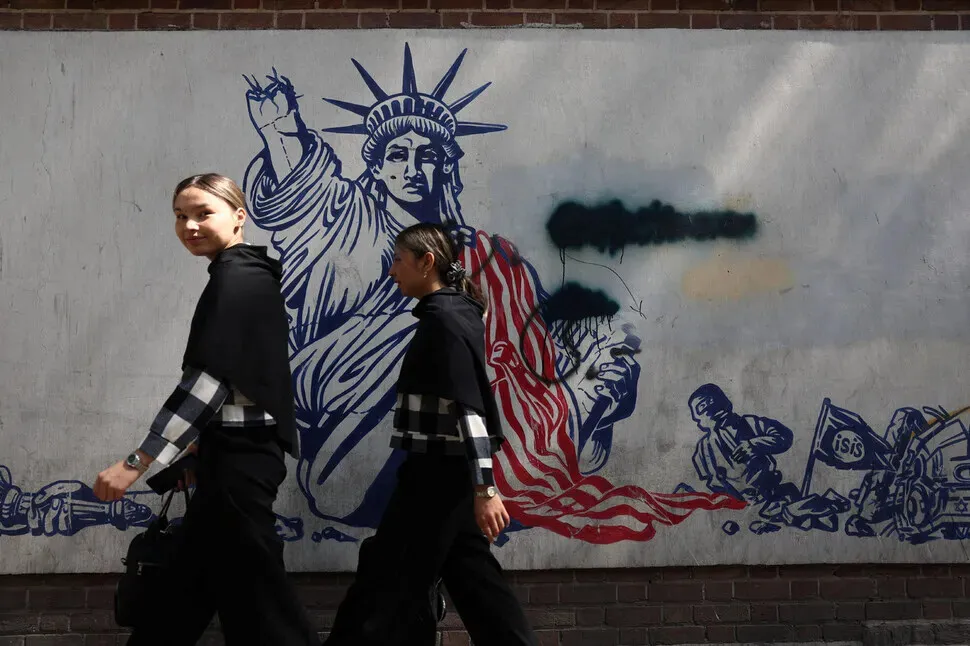
Women walk past an anti-American mural in Tehran, Iran, on June 30, 2026. (WANA/Reuters/Yonhap)When 31-year-old Jeong Si-hun, a Korean doctoral student at the University of Tehran, returned to Iran on June 20 for the first time in 101 days, he was struck by how the airport was bustling with people, even at 3 am. Imam Khomeini International Airport was overflowing with people setting off on trips abroad after travel plans had been put on hold due to the war, and people returning to Iran after Iran and the US signed a deal to stop their war. “It was almost impossible to believe that this country had been actively participating in war until very recently,” Jeong told the Hankyoreh during a telephone interview on Monday. Jeong, who left Iran on March 12, a little more than a week after the US and Israel initiated a war with Iran, returned to complete his PhD program after receiving permission from the Korean Foreign Ministry. He did not notice the tell-tale signs of war, such as the wrecked remains of buildings, on his way from the airport to his home in Tehran, or on his way to his school. The roads, which had been completely deserted following the war, were now full of traffic, and all seven lines of the Tehran subway system resumed operations, packed with people. He could no longer see soldiers stopping random people on the streets to interrogate them or any military vehicles, both of which had been common sights during the war. A significant amount of anti-US and anti-Israel propaganda produced by the Iranian government was displayed throughout the streets. However, a closer look revealed noticeable public dissatisfaction with Iran’s economic difficulties and with the government itself. The ramifications of war were most heavily reflected in the price tags in shops and restaurants. Prices for daily necessities rose by about 50% in the 100 days since Jeong left. Drink prices at cafes were now no different from those in Korea. “Prices at decent restaurants have risen to around 10,000 to 20,000 won per person. Considering how ordinary Iranian civilians usually earn around 300,000 to 500,000 won a month, eating out has become quite difficult to afford,” said Jeong. Currently, 1. 7 million rials are equivalent to about US$1, up roughly 20% from the exchange rate in December 2025, when it stood at 1. 4 million rials per dollar. A propaganda sign Jeong saw in Tehran on June 20, 2026, depicting US President Donald Trump and Israeli Prime Minister Benjamin Netanyahu and reading: “Trump and Netanyahu, like Zahhak, have become symbols of hatred and injustice fueled by war — predators of a new era. ” Zahhak, depicted on the left side of the poster, is a tyrannical ruler from the Shahnameh (Book of Kings), the epic poem written by the 10th-century Persian poet Ferdowsi. (courtesy Jeong)One local that Jeong met commented on how “sick and tired” they were. Jeong explained that Iranians, who had suffered from the ringing sounds of air raid sirens day and night during the war, wanted to put the memories of the war behind them as quickly as possible. Iranians who had hoped for regime change were left disheartened as the current government appeared more confident and strengthened after weathering the war. There was no sign of seething rage that would drive people to risk their lives in protest. The Iranian government tried to instill hope among its citizens, raising expectations that the economy would rebound once Western sanctions were lifted under the MOU signed with the US to end the war, as US$24 billion in funds frozen abroad would be released and up to US$300 billion in reconstruction funding would become available. “Even if those funds flow into Iran, no one knows where it will end up, so some Iranians seem skeptical. Those who have not really supported the government do not seem to have changed their minds significantly, even after the war,” Jeong commented. International news outlets have also reported that many people in Iran do not believe their lives will improve even if some sanctions are eased. The Wall Street Journal reported on June 29 that some Iranian civilians believe that any revenue from the lifting of oil sanctions will primarily strengthen the regime and its allies, rather than improve conditions for ordinary households. “We fear the ceasefire, an agreement and the survival of the regime more than we fear war itself,” a self-employed technician in Isfahan province told the outlet. Iranians more sympathetic to the regime who participated in written interviews with the Hankyoreh expressed their rage toward the US. “I believed that we would have to confront the US head-on at least once, so I did not feel anxious even during the war,” said a 26-year-old woman working as a math teacher at an Iranian high school, who asked not to be named. “The government of the Islamic Republic of Iran is the only government that has made no concessions and protected its territory with its own power,” she said. “The government brought comfort to those who had lost families by striking back at the US, which started the war. I had no particular feelings toward the US before the war, but now I hate it with a passion,” she said. Regarding the end-of-war agreement with the US, she said, “When considering the US’ long history of going back on its promises, I am very concerned. ”“I hope that corruption and favoritism, such as the allocation of contracts to specific parties, disappear within the national system, and that entrepreneurs can engage in business with peace of mind, and that we build a peaceful society with an economy free from foreign pressure,” she said when asked to comment on the direction that Iran should take for the future. A person walks in front of a massive billboard in Tehran depicting Iranian supreme leader Ali Khamenei kissing the head of Qasem Soleimani, the former Revolutionary Guard Quds Force commander killed in 2020. (AP/Yonhap)A 25-year-old stay-at-home mother living in Mashhad, the second largest city in Iran, voiced her suspicions by saying, “The price of goods has surged far more than the rises in gold prices or the dollar. It seems like a ploy devised by traitors within the system to anger the people and instigate riots. ”When asked to articulate her biggest wish, she said, “I want all the traitors to disappear and for Iran to regain the standing it rightly deserves and to once again bask in glory. ”By Kim Ji-hoon, staff reporterPlease direct questions or comments to [english@hani. co. kr]